You’ve heard dental implants are the gold standard for tooth replacement. But when you start researching, you find terms like single implant, implant-supported bridge, or dentures. Suddenly it feels complicated.
The good news is the choice usually comes down to one question. How many teeth are you missing, and where?
Dental implants can provide effective, permanent tooth replacement for patients seeking tooth replacement solutions. Dr. Ken Schweifler, offers multiple types of dental implants for Los Altos, Mountainview, and Palo Alto CA, and patients. He offers dental implants that can help patients replace lost teeth, no matter their unique dental circumstances.
Types of Dental Implants
Dr. Schweifler offers multiple types of dental implants in Palo Alto, Los Altos, for one or more missing teeth.
Option 1: Single Tooth Implant
Best for: One missing tooth, or a few missing teeth in different areas.
A single tooth implant replaces one tooth. A titanium post goes into your jaw. After healing, a custom crown is attached on top.
This is the most common implant option. It’s also the most conservative because it doesn’t affect your neighboring teeth.
Why patients choose it: You get a tooth that looks, feels, and functions like your natural one. You can brush and floss normally and don’t have to worry about it slipping or shifting.
What to know: The process takes several months from start to finish. It includes the implant placement, healing time, and crown placement. If you need bone grafting, add a few more months.
Single implant vs bridge: A bridge requires reshaping the teeth on either side of the gap. Those teeth have to support the bridge. A single implant leaves them untouched. If your neighboring teeth are healthy, an implant is often the better long-term choice.
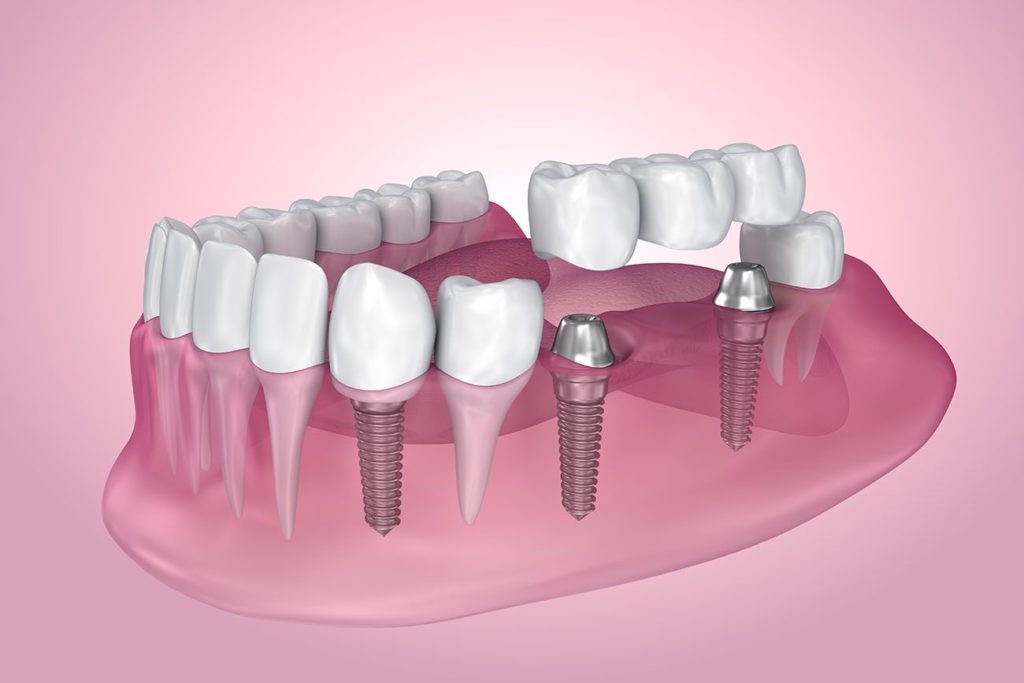
Option 2: Implant-Supported Bridge
Best for: Three or more consecutive missing teeth.
An implant-supported dental bridge uses two or more implants to anchor a bridge. The implants sit at each end of the gap. The bridge fills the space between them.
This option is ideal when you’re missing a row of teeth and want a fixed restoration. Unlike a traditional bridge, it doesn’t rely on your natural teeth for support.
Why patients choose it: You get a stable restoration that doesn’t slip. You can eat and speak normally. And you don’t have to reshape healthy teeth.
What to know: The process requires careful planning. Dr. Schweifler evaluates how many implants you need and where they should go. His KOIS Center training means he understands how to distribute force across the bridge so it functions properly.
Option 3: Implant Dentures
Best for: A full arch of missing teeth, or teeth that need a tooth extraction.
You can get dentures that use implants to support multiple teeth in different areas of the mouth or a full arch of replacement teeth. In some cases, we can place as few as 4 to 6 implants, angled strategically to maximize bone contact. This often allows patients to get a full arch restoration without bone grafting.
Why patients choose it: You get a full smile without worrying about sore gums and denture adhesive. Your dentures last longer with the support of implants and won’t need constant rebasing.
What to know: Implant-supported dentures require careful planning and a thorough evaluation. Dr. Schweifler will assess your bone density, gum health, and bite before recommending it. His Biorejuvenation approach means he looks at how the new arch will function with your jaw and muscles.
How to Decide Which Type of Dental Implant is For You
The right implant for you depends on a few factors:
- How many teeth are missing: One tooth points to a single implant. Several consecutive teeth point to an implant-supported bridge. A full arch points to dentures.
- Your bone health: Implants need enough bone to support them. If you’ve been missing teeth for years, you may need bone grafting first. That’s not a disqualifier. It’s just a step in the process.
- Your gum health: Healthy gums are essential. If you have gum disease, it needs treatment before implants. Dr. Schweifler will evaluate your gums as part of the consultation.
- Your bite:Your bite affects how implants function. Dr. Schweifler’s Biorejuvenation training means he evaluates how your teeth, jaw, and muscles work together. An implant placed without considering your bite can fail.
Questions to Ask at Your Implant Consultation
Your consultation is the time to get answers. Here are questions worth asking.
- How many implants do I need?
- Do I need bone grafting first?
- How long will the process take?
- What are the risks and how do you minimize them?
- How will you ensure the new tooth matches my other teeth?
- What’s the total cost, including follow-up visits?
Dr. Schweifler will answer all of these and explain the reasoning behind his recommendations.
Ask About Your Implant Options Today
Are you interested in implant treatment but want to know more? Dr. Schweifler provides dental implants and other tooth replacement solutions to patients in Palo Alto, Mountain View, Los Altos, CA, and the surrounding areas. To schedule a consultation with us, contact our staff online or reach us by phone at 650.489.4620.